L'ARENGARIO STUDIO BIBLIOGRAFICO - Dott. Paolo Tonini
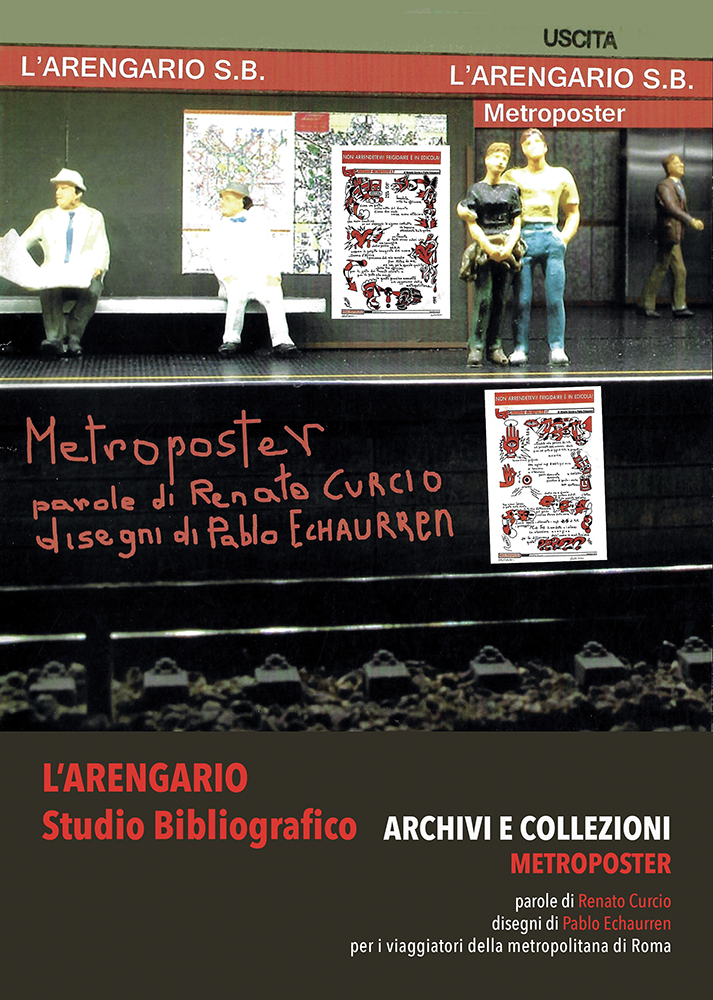
Metroposter - “Fogli underground di comunicazione orizzontale”. Collezione completa 1993-1994. Parole di Renato Curcio e disegni di Pablo Echaurren per i viaggiatori della metropolitana di Roma
Luogo: Cellatica
Editore: L'Arengario Studio Bibliografico, "Archivi e Collezioni"
Stampatore: prodotto in proprio
Anno: 2026 (21 settembre)
Legatura: brossura
Dimensioni: 29,7x21 cm.
Pagine: pp. XII - 15 (3)
Descrizione: copertina illustrata con un fotomontaggio a colori di Paolo Tonini. Opuscolo illustrato a colori, 15 schede ragionate. Testi di Pablo Echaurren («I metropposter»), Vincenzo Sparagna («Come nacquero i Metroposter»). Catalogo originale di tutto il pubblicato. Edizione digitale.
Bibliografia: N. D.
Prezzo: N. D.ORDINA / ORDER
"Pensammo che sarebbe stato bello prendere alcuni passi del libro («Metro» di Renato Curcio), isolarli e trasformarli in poster, in grafopitture, in manifesti per una comunicazione visiva collettiva, affinché in quella sospensione di ogni relazione diretta che è la Metro i viaggiatori si distraessero, leggessero e infine trovassero un frammento di vita, un punto di contatto tra sé e gli altri compagni della breve avventura. [...] Ne parlammo con Vincenzo Sparagna che subito ci offrì la sponda di Frigidaire. Così stampammo, diffondemmo e affiggemmo i nostri gloriosi Metroposter. Fogli di comunicazione orizzontale. [...] Ribaltamento della Metro come luogo di sbarramenti, cancelli, divieti, luogo di ferro e di cemento, luogo artificiale, sotterraneo, ctonio, privo di luce naturale, dove non c’è posto per fiori, piante, animali, sorrisi. [...] I nostri Metroposter volevano essere un piccolo spiraglio in questo universo avverso, fare uscire per un istante il lettore dal proprio bozzolo protettivo difensivo e offrirgli uno sguardo diverso su ciò che lo circondava, che lo inquietava. Non so se ci siamo riusciti, almeno però ci abbiamo provato. Se Majakovskij invitava gli artisti a usare le piazze come tavolozze e le strade come pennelli, noi abbiamo usato la metropolitana come un pennarello per creare un’affiche, come un’occasione per affrontare la questione murale di una società che tende a riprodurre isolamento e divisione" (dal testo di Pablo Echaurren).
"We thought it would be wonderful to take some passages from the book («Metro» by Renato Curcio) isolate them, and transform them into posters, grapho-paintings, and manifestos for collective visual communication. This way, in that suspension of any direct relationship that is the Metro, travelers could be distracted, read, and finally find a fragment of life, a point of contact between themselves and their fellow companions in that brief adventure. [...] We discussed this with Vincenzo Sparagna, who immediately offered us the support of Frigidaire. Thus, we printed, distributed, and put up our glorious Metroposters. Sheets of horizontal communication. [...] An overturning of the Metro as a place of barriers, gates, prohibitions, a place of iron and concrete, an artificial, underground, chthonic place, devoid of natural light, where there is no room for flowers, plants, animals, smiles. [...] Our Metroposters wanted to be a small glimmer of light in this adverse universe, to make readers step out of their protective, defensive cocoon for an instant and offer them a different perspective on what surrounded them, on what unsettled them. I do not know if we succeeded, but at least we tried. If Mayakovsky invited artists to use squares as palettes and streets as brushes, we used the subway like a marker pen to create an affiche, as an opportunity to tackle the mural question of a society that tends to reproduce isolation and division" (Pablo Echaurren).
DOWNLOAD PDF FILE
"We thought it would be wonderful to take some passages from the book («Metro» by Renato Curcio) isolate them, and transform them into posters, grapho-paintings, and manifestos for collective visual communication. This way, in that suspension of any direct relationship that is the Metro, travelers could be distracted, read, and finally find a fragment of life, a point of contact between themselves and their fellow companions in that brief adventure. [...] We discussed this with Vincenzo Sparagna, who immediately offered us the support of Frigidaire. Thus, we printed, distributed, and put up our glorious Metroposters. Sheets of horizontal communication. [...] An overturning of the Metro as a place of barriers, gates, prohibitions, a place of iron and concrete, an artificial, underground, chthonic place, devoid of natural light, where there is no room for flowers, plants, animals, smiles. [...] Our Metroposters wanted to be a small glimmer of light in this adverse universe, to make readers step out of their protective, defensive cocoon for an instant and offer them a different perspective on what surrounded them, on what unsettled them. I do not know if we succeeded, but at least we tried. If Mayakovsky invited artists to use squares as palettes and streets as brushes, we used the subway like a marker pen to create an affiche, as an opportunity to tackle the mural question of a society that tends to reproduce isolation and division" (Pablo Echaurren).
DOWNLOAD PDF FILE