L'ARENGARIO STUDIO BIBLIOGRAFICO - Dott. Paolo Tonini
Arte sociale - 30 documenti e libri d'artista
Luogo: Cellatica
Editore: L'Arengario Studio Bibliografico
Stampatore: prodotto in proprio
Anno: 2026 (28 luglio)
Legatura: brossura
Dimensioni: 29,7x21 cm.
Pagine: VI - 30 (2)
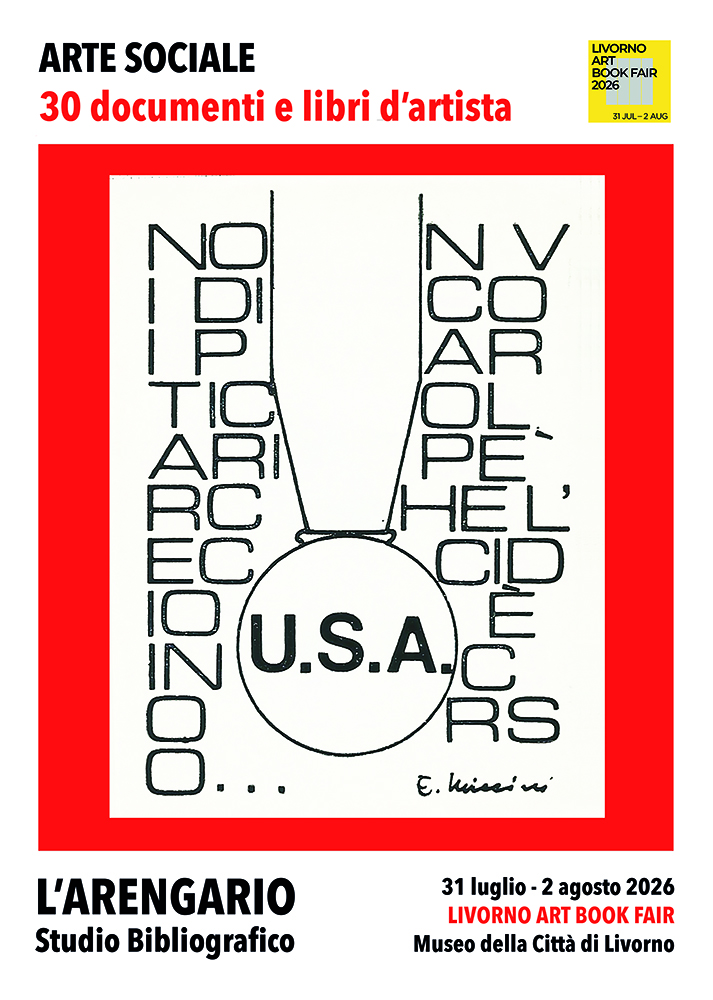
Descrizione: copertina illustrata con la riproduzione di una composizione verbovisiva di Eugenio Miccini. Catalogo illustrato a colori, 30 schede ragionate, a cura e con un testo di Paolo Tonini («Arte sociale e poesia» / «Social Art and Poetry». Pubblicato in occasione della Art Book Fair (Livorno, Museo di Livorno, 31 luglio - 2 agosto 2026). Edizione in formato digitale.
Bibliografia: N. D.
Prezzo: N. D.ORDINA / ORDER
"Gli anni ‘60 e ‘70 portarono all’estremo ogni possibile pratica creativa, scrittura, musica, pittura, arti plastiche... Pratiche che avevano in comune la stessa poiesis (ποίησις): bellezza, verità, felicità per tutti, un’arte sociale: occorreva creare zone liberate, con l’impegno di cambiare in meglio la vita e il mondo. Ma oggi fra le tante artificazioni accade raramente di incontrare la poesia: lo spettacolo ha eroso lo spazio della creazione trasformando ogni gesto di rivolta in stereotipi. Rimane la memoria. Appartengo all’ultima generazione sconfitta, quella che si è distrutta con l’eroina, forse l’ultima pienamente consapevole. Nel 1977 la prima pagina di una rivista autoprodotta lanciava lo slogan «NON prendere il potere». Perché non c’è niente di buono nel «potere», il potere è incapace di poesia. La poesia ha bisogno della verità come della bellezza e della felicità per non cadere nel tempo: tocca ai senza potere portarne finché possono il peso e la grazia" (dal testo introduttivo).
"The ‘60s and ‘70s pushed every possible creative practice - writing, music, painting, plastic arts - to the extreme. These practices shared the same poiesis (ποίησις): beauty, truth, and happiness for all; a social art: it was necessary to create liberated zones, bound by the commitment to change life and the world for the better. But today, amid so many artificialities, it is rare to encounter true poetry: the spectacle has eroded the space of creation, turning every gesture of revolt into stereotypes. Memory remains. I belong to the last defeated generation - the one that destroyed itself with heroin - perhaps the last to be fully conscious. In 1977, the front page of a self-published magazine launched the slogan «DO NOT take power». Because there is nothing good in «power»; power is incapable of poetry. Poetry needs truth just as it needs beauty and happiness so as not to fade into time: it falls to the powerless to carry its weight and its grace for as long as they can".
DOWNLOAD PDF FILE
"The ‘60s and ‘70s pushed every possible creative practice - writing, music, painting, plastic arts - to the extreme. These practices shared the same poiesis (ποίησις): beauty, truth, and happiness for all; a social art: it was necessary to create liberated zones, bound by the commitment to change life and the world for the better. But today, amid so many artificialities, it is rare to encounter true poetry: the spectacle has eroded the space of creation, turning every gesture of revolt into stereotypes. Memory remains. I belong to the last defeated generation - the one that destroyed itself with heroin - perhaps the last to be fully conscious. In 1977, the front page of a self-published magazine launched the slogan «DO NOT take power». Because there is nothing good in «power»; power is incapable of poetry. Poetry needs truth just as it needs beauty and happiness so as not to fade into time: it falls to the powerless to carry its weight and its grace for as long as they can".
DOWNLOAD PDF FILE